
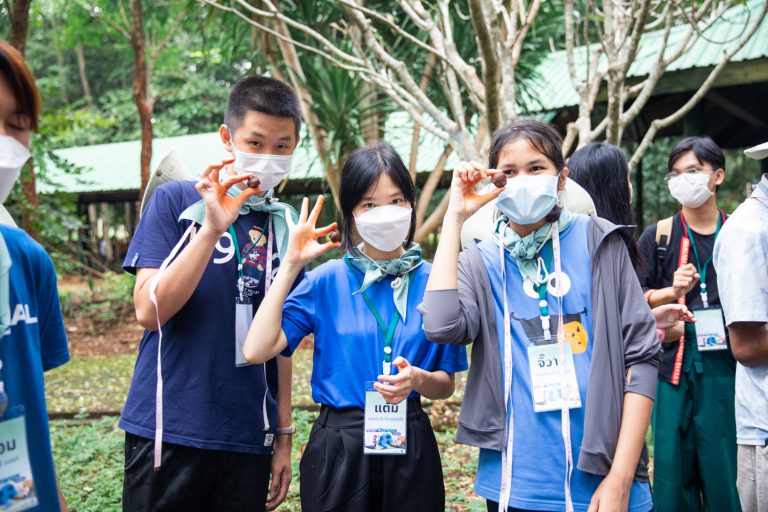
Empowering the Next Generation: Banpu’s Power Green Camp Transforms Youths into Environmental Leaders

Two Power Green Camp Alumni Recognized as “Outstanding Youth in Natural Resources and Environment,” a Proud Achievement Reflecting Thai Youth’s Potential and Banpu’s Commitment to Empowering the Next Generation in Environmental Stewardship.

The power of the new generation is “the hope of this world.” Amidst global volatility, which has led to widespread impacts, especially the increasingly severe environmental problems, supporting young people to participate, present ideas, and perspectives to protect the planet is crucial. This is not to instill fear of an uncertain future, but rather to raise awareness and demonstrate our belief in the potential of the new generation as a powerful source of hope, playing a vital role in creating a sustainable society and world.

For over 20 years, Banpu Public Company Limited has been committed to developing the potential of Thai youth through the Power Green Camp (PWG). This camp serves as a “nurturing platform” that has produced quality individuals spread across the country. The knowledge and experiences provided by the project to PWG youth have fostered a network of young leaders ready to drive change.

Currently, PWG has developed over 1,200 Thai youths. In the past two years, this success has been reinforced by PWG alumni who have won “Outstanding Children and Youth in Natural Resources and Environment” awards at the provincial level. The first is Noo Wan – Pannakorn Aomsin, a PWG Alumni 19, from Chalermprakiat Somdet Phra Srinakarin Kanchanaburi School. She recently received the “Outstanding Child and Youth in Natural Resources and Environment” award from the Kanchanaburi Provincial Children and Youth Council and the Kanchanaburi Provincial Home for Children and Families, on the occasion of Kanchanaburi Provincial Youth Day 2025.
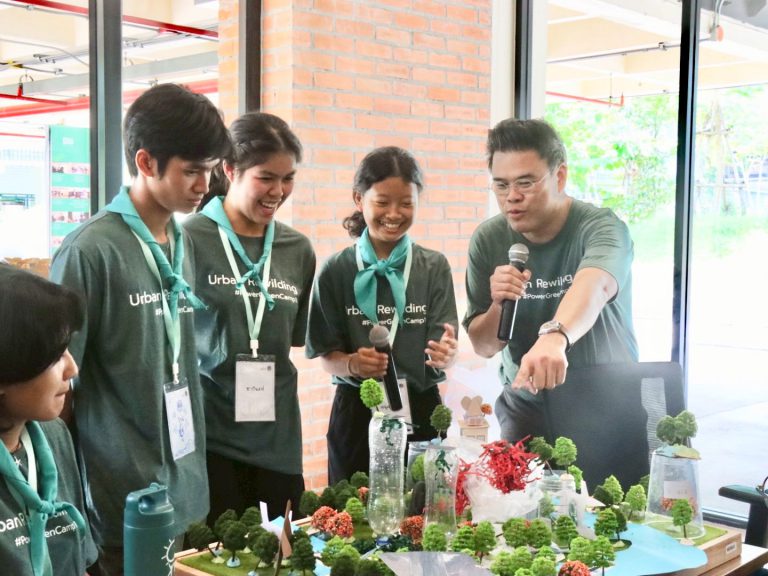
Noo Wan is a new-generation individual who believes, “I grew up with trees; they are our friends. If there are no trees, there is no us. I want to continue taking care of them.” This passion drove Noo Wan to join PWG19 in 2024, which was organized under the theme of “Urban Rewilding: Forest – Cities – Lives.” This theme resonated with Noo Wan’s interests and passion, as it emphasized that youth should reconnect with forests, understand ecosystems, and participate more in restoring the relationship between nature and the city.

“Joining PWG was a turning point in my life. It opened my world and allowed me to understand environmental problems in a broader and deeper dimension than ever before. That year, my team’s ‘tintin assistance’ application project, which we conceived and presented at the camp, won first prize. It wasn’t just an application for managing green spaces in the city, but an example of creative thinking that proved youth can truly change cities and the environment. And returning as a mentor for PWG20, in addition to passing on inspiration to the younger participants, was an opportunity for me to learn about carbon reduction, which was the main theme of the 20th camp. I also used that knowledge to further my own research project, studying the comparative efficiency of carbon dioxide absorption by various air-purifying plants, creating new knowledge building upon existing foundations.”

In addition to Noo Wan, another youth from the camp who received recognition and a certificate for “Outstanding Child and Youth in Natural Resources and Environment” from the Chiang Mai Provincial Children and Youth Council, in collaboration with the Chiang Mai Provincial Home for Children and Families, and the Chiang Mai Outstanding Youth Club for 2024, is Tee – Siriraj Yana, a PWG17. He is currently a first-year student in the Faculty of Engineering at King Mongkut’s University of Technology Thonburi.
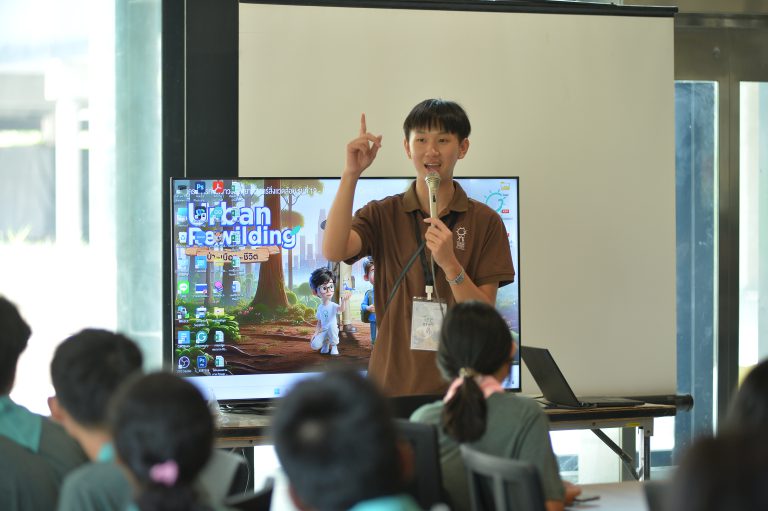
“As a Chiang Mai native, I face the PM 2.5 problem every year. This made me want to stand up and protect my family’s health and find a solution to this problem so that Chiang Mai can once again have clean air and we can breathe with confidence.”

Tee joined PWG17 in 2022, which focused on the theme “Climate Change, We Must Change,” with a determination to learn about climate change and apply that knowledge to solve the problems he and his community were facing. PWG opened Tee’s eyes to a deeper and more serious understanding of this issue. After the camp, he continued to drive serious of environmental actions, participating in various camps and projects in Chiang Mai, organizing environmental activities, and taking on the role of a youth leader to push for changes, including as a member of the Chiang Mai Provincial Children and Youth Council, founder of the YRC Green Generation youth group, and the GreenerThailand page. Tee’s efforts began to raise widespread awareness, leading to recognition and ultimately winning the “Outstanding Youth in Natural Resources and Environment” award.
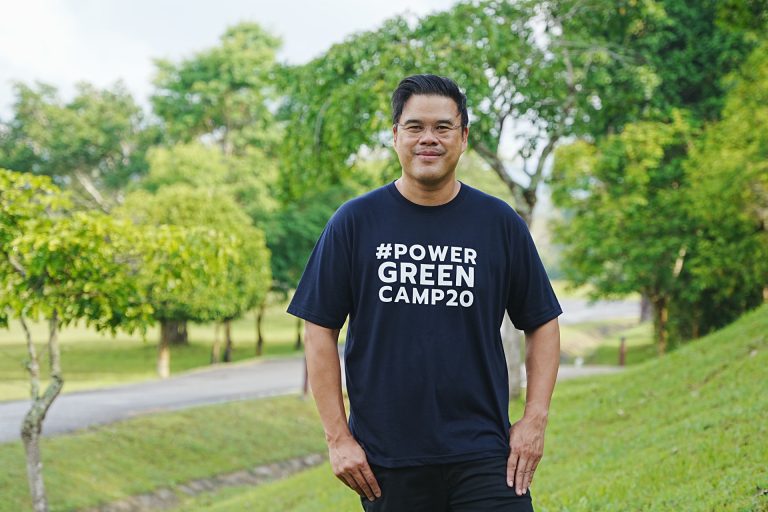
Mr. Rattapon Sukhunthee, Head of Corporate Communications at Banpu Public Company Limited, stated, “Power Green Camp is Thailand’s longest-running environmental science camp. We continuously strive to develop content that is relevant to current environmental situations and challenges. Our success is not just about the overwhelming interest from young people who apply each year, but about seeing these youths take what they’ve learned at the camp and apply it to their own communities, both as leaders of community change and as inspirers for those around them. I would like to congratulate Noo Wan and Tee, and I believe that all the youths in the Power Green network have also built upon the knowledge from the camp in their own unique ways.”

Follow the activities and details of the “Power Green Camp” environmental science youth project at https://www.facebook.com/powergreencamp


###


About Power Green Camp 

The “Power Green Camp,” launched in 2006, has been continuously organized through a collaboration between Banpu Public Company Limited and the Faculty of Environment and Resource Studies at Mahidol University. Guided by the concept of “Environmental Science – Learning to Practice,” the camp’s mission is to equip students with knowledge about the environment and natural resources, inspire participants to develop a deep appreciation for nature while empowering them to apply scientific principles to address environmental challenges systematically. Additionally, the program aims to nurture future leaders and foster a strong network dedicated to environmental protection.

About Banpu

Banpu Public Company Limited is a versatile energy company, operating across three core groups of businesses – energy resources, energy generation, and energy technology – with operations in Thailand, Indonesia, China, Australia, Lao PDR, Mongolia, Japan, the United States of America, and Vietnam. The Company leads a responsible and sustainable energy transition by balancing reliable, affordable and sustainable energy.

About Banpu CSR

Banpu Public Company Limited, a leading diversified energy company, elevates its corporate social responsibility initiatives to Purpose-driven CSR under the guiding principle: “Embracing Potential, Energizing People” This philosophy underscores Banpu’s dedication to generating sustainable benefits and value for communities, society, and the environment through the development of “people,” our most invaluable resource. Banpu’s CSR strategically focuses on four key areas of human potential development:

  • Intellectual Enhancement
  • Wealth & Wellbeing
  • Earth Betterment
  • Energy Sustainability
Tags :
For more information,
Please contact Banpu Corporate
Communications Team:
Kamolwan Chiamudom

093-923-6355

Kamolwan_c@banpu.co.th

Thanatchaporn Rangsinturat

099-104-4999

Thanatchaporn_R@banpu.co.th

Solar Farm
Ponder Solar Farm
Texas

Operational

Capacity
(1Q26)

2.5
MW
Banpu Ownership : 100%
Gas-fired Power Plant (HELE/CCGT)
Temple I CCGT Power Plant
Texas

Operational

Installed
capacity
(1Q26)

768
MW
Banpu Ownership : 100%
Temple II CCGT Power Plant
Texas

Operational

Installed
capacity
(1Q26)

755
MW
Banpu Ownership : 100%
Shale Gas Site
Marcellus Shale
Pennsylvania

Operational

Reserves
(2025)

0.6
Tcfe 1P reserves
Banpu Ownership : 65.94%
Barnett Shale
Texas

Operational

Reserves
(2025)

5.5
Tcfe 1P reserves
Banpu Ownership : 65.94%
CCUS Project
Barnett Zero Project
Texas

Operational

Annual CO2
storage capacity
(2025)

183,000
t/yr
Cotton Cove Project
Texas

Operational

Annual CO2
storage capacity
(2025)

32,000
t/yr
CCUS Project
Eagle Ford Project
Southern Texas

Under Development

Annual CO2
storage capacity
(2025)

~90,000
t/yr
East Texas Project
Eastern Texas

Under Development

Annual CO2
storage capacity
(2025)

~70,000
t/yr
BESS Project
Megamouth BESS
Texas

Under Development

Capacity
(2025)

100
MW
200
MWh
Banpu Ownership : 100%
BESS Project
Iwate Tono BESS
Iwate

Operational

Capacity
(1Q26)

15
MW
58
MWh
Banpu Ownership : 75%
BESS Project
Aizu BESS
Fukushima

Under Development

Capacity
(2025)

26
MW
104
MWh
Banpu Ownership : 100%
Tsuno BESS
Miyazaki

Under Development

Capacity
(2025)

26
MW
104
MWh
Banpu Ownership : 70%
Kamigumi-Tokyo BESS
Tokyo

Under Development

Capacity
(2025)

2
MW
8
MWh
Banpu Ownership : 49%
Nikko BESS
Tochigi ​

Under Development

Capacity
(2025)

40
MW
160
MWh
Banpu Ownership : 100%
Hiyoshibaru BESS
Oita​

Under Development

Capacity
(2025)

20
MW
80
MWh
Banpu Ownership : 30%
Solar Power Plant
Olympia Solar
Gunma, Ibaraki and Tochigi

Operational

Capacity
(1Q26)

10
MW
Banpu Ownership : 40%
Yamagata Solar​
Yamagata

Operational

Capacity
(1Q26)

20
MW
Banpu Ownership : 100%
Kesennuma Solar
Miyagi

Operational

Capacity
(1Q26)

20
MW
Banpu Ownership : 100%
Shirakawa Solar​
Fukushima

Operational

Capacity
(1Q26)

10
MW
Banpu Ownership : 100%
Wind Project
Vinh Chau – Phase 1
Soc Trang Province

Under Development

Capacity
(2025)

30
MW
Banpu Ownership : 100%
Solar Power Plant
Nhon Hai Solar
Ninh Thuan Province

Operational

Capacity
(1Q26)

35
MW
Banpu Ownership : 100%
Wind Power Plant
El Wind Mui Dinh
Ninh Thuan Province

Operational

Capacity
(1Q26)

37.60
MW
Banpu Ownership : 100%
Coal Mine
Tsant Uul Mine
South Gobi Province

Operational

Production
(1Q26)

0.57
Mt

Reserves
(2025)

~63.5
Mt
Banpu Ownership : 100%
Coal Project
Unst Khudag Project
Central Gobi Province

Under Development

Reserves
(2025)

540.9
Mt
Banpu Ownership : 100%
Solar Farm
Beryl Solar Farm (BSF)
New South Wales

Operational

Capacity
(1Q26)

110.9
MW
Banpu Ownership : 100%
Manildra Solar Farm (MSF)
New South Wales

Operational

Capacity
(1Q26)

55.9
MW
Banpu Ownership : 100%
Port
NCIG Coal Terminal Port (Newcastle)

Operational

Coal export loading

Coal Mine
Airly Mine
New South Wales

Operational

Production
(1Q26)

0.1
Mt

Reserves
(2025)

13.5
Mt
Banpu Ownership : 100%
Springvale Mine
New South Wales

Operational

Production
(1Q26)

0.7
Mt

Reserves
(2025)

5.3
Mt
Banpu Ownership : 100%
Clarence Mine
New South Wales

Operational

Production
(1Q26)

0.3
Mt

Reserves
(2025)

24.7
Mt
Banpu Ownership : 100%
Mandalong Mine
New South Wales

Operational

Production
(1Q26)

0.5
Mt

Reserves
(2025)

43.9
Mt
Banpu Ownership : 100%
Myuna Mine
New South Wales

Operational

Production
(1Q26)

0.2
Mt

Reserves
(2025)

11.5
Mt
Banpu Ownership : 100%
Angus Place Mine
New South Wales

Care & Maintenance

On care & maintenance

Banpu Ownership : 100%
BESS Project
Wooreen BESS (WESS)
Latrobe Valley

Under Development

Capacity
(2025)

350
MW
1,400
MWh
Banpu Ownership : 50%
Kerang BESS
Latrobe Valley

Under Development

Capacity
(2025)

103
MW
206
MWh
Banpu Ownership : 100%
Coal Project
Newstan Extension Project
New South Wales

Under Development

Reserves
(2025)

51.5
Mt
Banpu Ownership : 100%
Neubecks Mine Project
New South Wales

Under Development

Reserves
(2025)

7.5
Mt
Banpu Ownership : 100%
Wallarah Mine Project
New South Wales

Under Development

Reserves
(2025)

7.8
Mt (equity basis)​
Banpu Ownership : 13.5%
Port
Bontang Coal Terminal
+ 4 ports

Operational

Export loading facility

Coal Project
NPR Mine Project
Central Kalimantan

Under Development

Reserves
(pre-development)

77.4
Mt
Banpu Ownership : 65.14%
Coal Mine
Indominco Mine
East Kalimantan

Operational

Production
(1Q26)

1.6
Mt

Reserves
(2025)

30.4
Mt
Banpu Ownership : 65.14%
Trubaindo Mine
East Kalimantan

Operational

Production
(1Q26)

0.7
Mt

Reserves
(2025)

50.2
Mt
Banpu Ownership : 65.14%
Bharinto Mine
North Barito

Operational

Production
(1Q26)

1.7
Mt

Reserves
(2025)

95.4
Mt
Banpu Ownership : 65.14%
Jorong Mine
South Kalimantan

Operational

Reserves
(2025)

2.3
Mt
Banpu Ownership : 65.14%
Graha Panca Karsa Mine (GPK)
East Kalimantan

Operational

Production
(1Q26)

0.5
Mt

Reserves
(2025)

99.1
Mt
Banpu Ownership : 65.14%
TIS Mine
East Kalimantan

Operational

Production
(1Q26)

0.1
Mt

Reserves
(2025)

7.2
Mt
Banpu Ownership : 65.14%
NPR Mine

Operational

Production
(1Q26)

0.1
Mt

Reserves
(2025)

77.4
Mt
Banpu Ownership : 65.14%
Thermal Power Plant
Hongsa Power Plant – HPC
Xayaboury Province

Operational

Installed Capacity
(1Q26)

1,878
MW
Banpu Ownership : 40%
Thermal Power Plant
BLCP Power Plant
Rayong Province

Operational

Installed Capacity
(1Q26)

1,434
MW
Banpu Ownership : 50%
Solar Project
Jinhu Qianfeng Solar
Jiangsu Province

Under Development

Capacity
(2025)

120
MW
Banpu Ownership : 10%
BESS Project
Jinhu Qianfeng BESS
Jiangsu Province

Under Development

Capacity
(2025)

10
MW
20
MWh
Banpu Ownership : 100%
Thermal Power Plants
Luannan CHP
Hebei Province

Operational

Capacity
(1Q26)

246
MW

Steam
(1Q26)

538
t/hr​
Banpu Ownership : 100%
Zhengding CHP
Hebei Province

Operational

Capacity
(1Q26)

139
MW

Steam
(1Q26)

370
t/hr​
Banpu Ownership : 100%
Zouping CHP
Shandong Province

Operational

Capacity
(1Q26)

223
MW

Steam
(1Q26)

600
t/hr​
Banpu Ownership : 70%
Shanxi Lu Guang (SLG) Power Plant​
Shanxi Province

Operational

Capacity
(1Q26)

1,320
MW
Banpu Ownership : 30%
Solar Power Plant
Huineng Solar
Shandong Province

Operational

Capacity
(1Q26)

21.51
MW
Banpu Ownership : 100%
Jinshan Solar
Shandong Province

Operational

Capacity
(1Q26)

28.95
MW
Banpu Ownership : 100%
Haoyuan Solar
Shandong Province

Operational

Capacity
(1Q26)

20.00
MW
Banpu Ownership : 100%
Hui'en Solar
Shandong Province

Operational

Capacity
(1Q26)

19.70
MW
Banpu Ownership : 100%
Deyuan Solar
Zhejiang Province

Operational

Capacity
(1Q26)

51.64
MW
Banpu Ownership : 100%
Xingyu Solar
Shandong Province

Operational

Capacity
(1Q26)

10.30
MW
Banpu Ownership : 100%
Jixin Solar
Jiangsu Province

Operational

Capacity
(1Q26)

25.22
MW
Banpu Ownership : 100%
Coal Mine
Gaohe Mine
Shanxi Province

Operational

Production
(1Q26)

2.6
Mt

Reserves
(2025)

72.9
Mt
Banpu Ownership : 45%
Hebi Mine
Henan Province

Operational

Production
(1Q26)

0.3
Mt

Reserves
(2025)

40.6
Mt
Banpu Ownership : 40%

IR Contacts