
Digital Twins: The AI Technology Driving Banpu’s Energy Operations Efficiency

In the energy industry, production, transportation, and management processes operate continuously around the clock. Every moment a system underperforms leads to energy waste, rising costs, and unnecessary carbon emissions. Banpu Public Company Limited, a versatile energy company, has integrated digital technology to elevate operational performance. One of the key digital solutions is Digital Twins, which simulates and analyzes energy system operations in real time to improve efficiency, reduce costs, and support sustainable operations.

Digital Twins: What is it and How Does It Work?

Digital Twins are virtual replicas that connect real-world operational data to the digital world in real time, enabling continuous simulation, prediction, and optimization of systems. By mirroring a physical asset or process digitally, operators can monitor, analyze, and anticipate performance in advance, therefore referred to as the ‘twins’ of the physical system.

With the deployment of IoT (Internet of Things) sensors on machinery, the system collects data such as equipment conditions, production volumes, and logistics status of each operational point. The data is then transmitted to a digital system for AI-powered analysis. Advances in AI have made it possible to analyze and optimize operations in near real time, presenting results in a clear, accessible format that enables both operators and executives to make faster, more informed decisions. Banpu has applied this technology within its Next-Gen Mining business, one of its four core business pillars, to improve operational efficiency, reduce discrepancies, and enhance data-driven decision-making.

Elevating Efficiency from Mine to Port

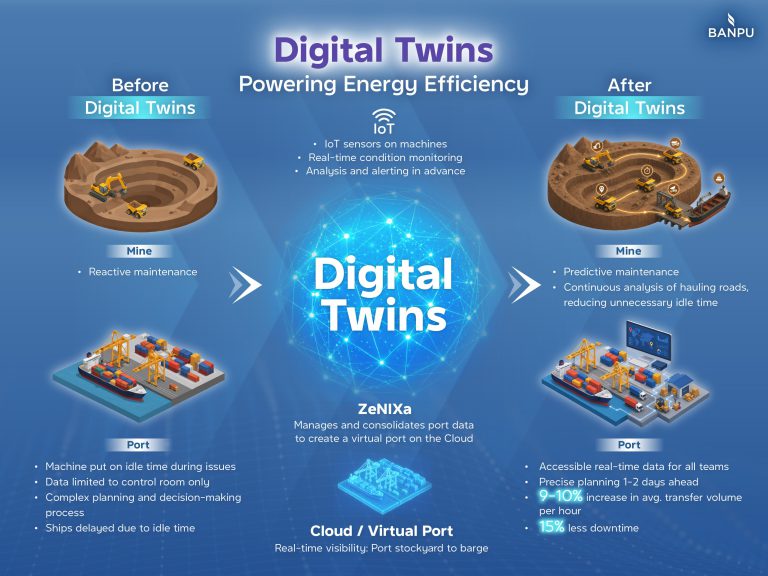
Mining and port operations have historically faced significant constraints: data scattered across multiple systems, communication dependent on manual processes causing delays, and machinery idling, all contributing to higher costs and underutilized equipment capacity. Banpu has addressed these challenges by deploying Digital Twins at its coal mine and Bunyut Port in Indonesia, installing IoT systems on machinery to continuously collect and analyze operational data, shifting from reactive operations to systematic and predictive planning.

At the mine site, IoT data enables continuous analysis of hauling roads and equipment conditions, transitioning the operation from Reactive Maintenance (addressing problems after they occur) to Predictive Maintenance, which schedules servicing in advance, improving overall production output, fuel efficiency, and logistics performance, while reducing unnecessary idle time.

At the port, Banpu developed ZeNIXa, a Digital Twins platform that integrates data from machinery and logistics processes into a centralized digital system. ZeNIXa provides real-time visibility across the full production chain, from the Port Stockyard (PSY) through to cargo vessel loading. Previously, operational data was confined to the control room and communicated via radio or manual reports, causing delays in decision-making. ZeNIXa enables all teams to access the same data instantly, regardless of location, improving planning accuracy and cross-functional coordination. The process allows logistics planning 1 to 2 days ahead, particularly in aligning vessel schedules with available coal volumes, reducing demurrage costs, and improving inventory management accuracy.

Furthermore, improved conveyor belt continuity has reduced equipment idle time by approximately 15%. Loading rates have become more stable, increasing average throughput from 2,600 tons per hour to 2,900 tons per hour, a gain of approximately 9 to 10%, reflecting enhanced equipment utilization through more continuous and efficient operational processes.

Long-Term Value Across the Organization, Environment, and End Consumers

Digital Twins connect Banpu’s operations from the field through to executive decision-making. Real-time data from mines and ports enables operators to monitor and adjust operations in real time, reducing process steps and communication errors while providing access to shared data that eliminates duplication and improves operational continuity. Office-based teams can analyze and plan with greater precision, while executives gain a comprehensive overview to support faster, data-driven decisions.

Improved efficiency in production and logistics, combined with reduced carbon emissions and the elimination of unnecessary costs, contributes to lower overall energy costs in the long run, benefiting consumers and society through more equitable access to energy, fair and reasonable pricing, and responsible stewardship of society and the environment.

Banpu’s systematic and continuous investment in Digital Twins paves the way for the Company to utilize every unit of energy efficiently, minimize waste, and create value concurrently. This reflects the use of technology to advance Banpu’s diverse new-era energy business in line with its Energy Symphonics strategy, supporting the responsible expansion of global energy capacity and creating sustainable value for all stakeholders.

Dr. Kirana Limpaphayom, Chief Operating Officer of Banpu Public Company Limited, stated, “Banpu believes that today’s energy challenge lies in managing a diverse range of energy sources to work together with maximum efficiency. Digital Twins are a critical tool that enables us to connect data from real operations and gain a holistic view of our energy systems, from operational level through to strategic decision-making. The results achieved in Indonesia demonstrate that we can deliver measurable efficiency improvements, manage costs, and create asset value while conducting our business responsibly. This is the approach Banpu will apply as we expand our energy capabilities and grow alongside the countries where we operate.”


###


About Banpu

Banpu Public Company Limited is a versatile energy company, operating across four business pillars under its Energy Symphonics Strategy: Next-Gen Mining, U.S. Closed-Loop Gas, Power+, and Future Tech – with operations in Thailand, Indonesia, China, Australia, Lao PDR, Mongolia, Japan, the United States of America, and Vietnam. The Company leads a responsible and sustainable energy transition by balancing reliable, affordable and sustainable energy.

Tags :
Solar Farm
Ponder Solar Farm
Texas

Operational

Capacity
(1Q26)

2.5
MW
Banpu Ownership : 100%
Gas-fired Power Plant (HELE/CCGT)
Temple I CCGT Power Plant
Texas

Operational

Installed
capacity
(1Q26)

768
MW
Banpu Ownership : 100%
Temple II CCGT Power Plant
Texas

Operational

Installed
capacity
(1Q26)

755
MW
Banpu Ownership : 100%
Shale Gas Site
Marcellus Shale
Pennsylvania

Operational

Reserves
(2025)

0.6
Tcfe 1P reserves
Banpu Ownership : 65.94%
Barnett Shale
Texas

Operational

Reserves
(2025)

5.5
Tcfe 1P reserves
Banpu Ownership : 65.94%
CCUS Project
Barnett Zero Project
Texas

Operational

Annual CO2
storage capacity
(2025)

183,000
t/yr
Cotton Cove Project
Texas

Operational

Annual CO2
storage capacity
(2025)

32,000
t/yr
CCUS Project
Eagle Ford Project
Southern Texas

Under Development

Annual CO2
storage capacity
(2025)

~90,000
t/yr
East Texas Project
Eastern Texas

Under Development

Annual CO2
storage capacity
(2025)

~70,000
t/yr
BESS Project
Megamouth BESS
Texas

Under Development

Capacity
(2025)

100
MW
200
MWh
Banpu Ownership : 100%
BESS Project
Iwate Tono BESS
Iwate

Operational

Capacity
(1Q26)

15
MW
58
MWh
Banpu Ownership : 75%
BESS Project
Aizu BESS
Fukushima

Under Development

Capacity
(2025)

26
MW
104
MWh
Banpu Ownership : 100%
Tsuno BESS
Miyazaki

Under Development

Capacity
(2025)

26
MW
104
MWh
Banpu Ownership : 70%
Kamigumi-Tokyo BESS
Tokyo

Under Development

Capacity
(2025)

2
MW
8
MWh
Banpu Ownership : 49%
Nikko BESS
Tochigi ​

Under Development

Capacity
(2025)

40
MW
160
MWh
Banpu Ownership : 100%
Hiyoshibaru BESS
Oita​

Under Development

Capacity
(2025)

20
MW
80
MWh
Banpu Ownership : 30%
Solar Power Plant
Olympia Solar
Gunma, Ibaraki and Tochigi

Operational

Capacity
(1Q26)

10
MW
Banpu Ownership : 40%
Yamagata Solar​
Yamagata

Operational

Capacity
(1Q26)

20
MW
Banpu Ownership : 100%
Kesennuma Solar
Miyagi

Operational

Capacity
(1Q26)

20
MW
Banpu Ownership : 100%
Shirakawa Solar​
Fukushima

Operational

Capacity
(1Q26)

10
MW
Banpu Ownership : 100%
Wind Project
Vinh Chau – Phase 1
Soc Trang Province

Under Development

Capacity
(2025)

30
MW
Banpu Ownership : 100%
Solar Power Plant
Nhon Hai Solar
Ninh Thuan Province

Operational

Capacity
(1Q26)

35
MW
Banpu Ownership : 100%
Wind Power Plant
El Wind Mui Dinh
Ninh Thuan Province

Operational

Capacity
(1Q26)

37.60
MW
Banpu Ownership : 100%
Coal Mine
Tsant Uul Mine
South Gobi Province

Operational

Production
(1Q26)

0.57
Mt

Reserves
(2025)

~63.5
Mt
Banpu Ownership : 100%
Coal Project
Unst Khudag Project
Central Gobi Province

Under Development

Reserves
(2025)

540.9
Mt
Banpu Ownership : 100%
Solar Farm
Beryl Solar Farm (BSF)
New South Wales

Operational

Capacity
(1Q26)

110.9
MW
Banpu Ownership : 100%
Manildra Solar Farm (MSF)
New South Wales

Operational

Capacity
(1Q26)

55.9
MW
Banpu Ownership : 100%
Port
NCIG Coal Terminal Port (Newcastle)

Operational

Coal export loading

Coal Mine
Airly Mine
New South Wales

Operational

Production
(1Q26)

0.1
Mt

Reserves
(2025)

13.5
Mt
Banpu Ownership : 100%
Springvale Mine
New South Wales

Operational

Production
(1Q26)

0.7
Mt

Reserves
(2025)

5.3
Mt
Banpu Ownership : 100%
Clarence Mine
New South Wales

Operational

Production
(1Q26)

0.3
Mt

Reserves
(2025)

24.7
Mt
Banpu Ownership : 100%
Mandalong Mine
New South Wales

Operational

Production
(1Q26)

0.5
Mt

Reserves
(2025)

43.9
Mt
Banpu Ownership : 100%
Myuna Mine
New South Wales

Operational

Production
(1Q26)

0.2
Mt

Reserves
(2025)

11.5
Mt
Banpu Ownership : 100%
Angus Place Mine
New South Wales

Care & Maintenance

On care & maintenance

Banpu Ownership : 100%
BESS Project
Wooreen BESS (WESS)
Latrobe Valley

Under Development

Capacity
(2025)

350
MW
1,400
MWh
Banpu Ownership : 50%
Kerang BESS
Latrobe Valley

Under Development

Capacity
(2025)

103
MW
206
MWh
Banpu Ownership : 100%
Coal Project
Newstan Extension Project
New South Wales

Under Development

Reserves
(2025)

51.5
Mt
Banpu Ownership : 100%
Neubecks Mine Project
New South Wales

Under Development

Reserves
(2025)

7.5
Mt
Banpu Ownership : 100%
Wallarah Mine Project
New South Wales

Under Development

Reserves
(2025)

7.8
Mt (equity basis)​
Banpu Ownership : 13.5%
Port
Bontang Coal Terminal
+ 4 ports

Operational

Export loading facility

Coal Project
NPR Mine Project
Central Kalimantan

Under Development

Reserves
(pre-development)

77.4
Mt
Banpu Ownership : 65.14%
Coal Mine
Indominco Mine
East Kalimantan

Operational

Production
(1Q26)

1.6
Mt

Reserves
(2025)

30.4
Mt
Banpu Ownership : 65.14%
Trubaindo Mine
East Kalimantan

Operational

Production
(1Q26)

0.7
Mt

Reserves
(2025)

50.2
Mt
Banpu Ownership : 65.14%
Bharinto Mine
North Barito

Operational

Production
(1Q26)

1.7
Mt

Reserves
(2025)

95.4
Mt
Banpu Ownership : 65.14%
Jorong Mine
South Kalimantan

Operational

Reserves
(2025)

2.3
Mt
Banpu Ownership : 65.14%
Graha Panca Karsa Mine (GPK)
East Kalimantan

Operational

Production
(1Q26)

0.5
Mt

Reserves
(2025)

99.1
Mt
Banpu Ownership : 65.14%
TIS Mine
East Kalimantan

Operational

Production
(1Q26)

0.1
Mt

Reserves
(2025)

7.2
Mt
Banpu Ownership : 65.14%
NPR Mine

Operational

Production
(1Q26)

0.1
Mt

Reserves
(2025)

77.4
Mt
Banpu Ownership : 65.14%
Thermal Power Plant
Hongsa Power Plant – HPC
Xayaboury Province

Operational

Installed Capacity
(1Q26)

1,878
MW
Banpu Ownership : 40%
Thermal Power Plant
BLCP Power Plant
Rayong Province

Operational

Installed Capacity
(1Q26)

1,434
MW
Banpu Ownership : 50%
Solar Project
Jinhu Qianfeng Solar
Jiangsu Province

Under Development

Capacity
(2025)

120
MW
Banpu Ownership : 10%
BESS Project
Jinhu Qianfeng BESS
Jiangsu Province

Under Development

Capacity
(2025)

10
MW
20
MWh
Banpu Ownership : 100%
Thermal Power Plants
Luannan CHP
Hebei Province

Operational

Capacity
(1Q26)

246
MW

Steam
(1Q26)

538
t/hr​
Banpu Ownership : 100%
Zhengding CHP
Hebei Province

Operational

Capacity
(1Q26)

139
MW

Steam
(1Q26)

370
t/hr​
Banpu Ownership : 100%
Zouping CHP
Shandong Province

Operational

Capacity
(1Q26)

223
MW

Steam
(1Q26)

600
t/hr​
Banpu Ownership : 70%
Shanxi Lu Guang (SLG) Power Plant​
Shanxi Province

Operational

Capacity
(1Q26)

1,320
MW
Banpu Ownership : 30%
Solar Power Plant
Huineng Solar
Shandong Province

Operational

Capacity
(1Q26)

21.51
MW
Banpu Ownership : 100%
Jinshan Solar
Shandong Province

Operational

Capacity
(1Q26)

28.95
MW
Banpu Ownership : 100%
Haoyuan Solar
Shandong Province

Operational

Capacity
(1Q26)

20.00
MW
Banpu Ownership : 100%
Hui'en Solar
Shandong Province

Operational

Capacity
(1Q26)

19.70
MW
Banpu Ownership : 100%
Deyuan Solar
Zhejiang Province

Operational

Capacity
(1Q26)

51.64
MW
Banpu Ownership : 100%
Xingyu Solar
Shandong Province

Operational

Capacity
(1Q26)

10.30
MW
Banpu Ownership : 100%
Jixin Solar
Jiangsu Province

Operational

Capacity
(1Q26)

25.22
MW
Banpu Ownership : 100%
Coal Mine
Gaohe Mine
Shanxi Province

Operational

Production
(1Q26)

2.6
Mt

Reserves
(2025)

72.9
Mt
Banpu Ownership : 45%
Hebi Mine
Henan Province

Operational

Production
(1Q26)

0.3
Mt

Reserves
(2025)

40.6
Mt
Banpu Ownership : 40%

IR Contacts